

The wheelbarrow wheel slipped off the board again.
There was a particular misery in that small sideways movement. A moment earlier, Ed had been pushing his load toward the manure pile. Now the wheel was down in the barnyard, the handles were at an inconvenient angle, and the rest of the job required him to get into the mud and put everything back where it belonged. Rain had helped make the trouble. Rain would be there when he finished, waiting to assist the next trip.
The board was about twelve inches wide. That gave a boy a narrow route across a yard where the cows contributed generously to the conditions underfoot. His task was to keep the wheel on the board, move the manure, and do it again. The repetition was built into the arrangement.
My grandfather could describe this chore decades later with the freshness of someone whose boot had just gone into the wrong place. He remembered the wetness, the slipping wheel, and the fundamental problem with the entire operation: after you cleaned the barn, the cows came back.
They undid your work with remarkable confidence.
“What are we doing this for?” he used to ask.
His mother, Violet, had an explanation readily available. He was lazy.
Ed had another explanation. The job needed a conveyor belt.
That difference of opinion is one of my favorite introductions to the boy he had been. Violet saw a chore that required doing and a son offering objections. Ed saw a poorly arranged system and the possibility of improving it. Both perspectives were there in the yard and neither one got the manure to the pile until somebody took hold of the wheelbarrow.
He once told me how he had tried to figure out a conveyor that could carry the stuff away. I remember the idea more clearly than any prospect of its being finished: the barn would keep producing work, but maybe a machine could take over the part he disliked most. His mind had found somewhere to go while his feet were occupied in the mud.
I picture him lifting the handles, getting the wheel back onto the board, and beginning another careful push. The farm didn’t pause for invention. There was time to think about machinery while doing the work, but thought alone left the barn exactly as it was.
He would have to finish.
Ed was born in 1926, into a Lopez Island family whose work reached both the farm and the water. His father, Art, ran boats and worked on them. His mother kept a household whose requirements included making sure the children did what needed doing. His brother was also Art. Doug belonged to the family stories too, and there were other relatives nearby, connected by visits, work, and the ordinary geography of the island.
The names can become a little tangled when the stories get moving. The chores are easier to follow. Whatever anybody was called, a cow had to be milked. Whatever a boy hoped to become, he could be needed in the barn before he got there.
The family farm was part of a larger pattern. On Lopez, people made their living from several kinds of work, depending on the season. They kept animals, tended orchards, grew crops, and took boats out when the fishing offered a chance to earn. An occupation could be something a person did during part of the year, rather than the single answer he gave for the rest of his life.
The connection between land and sea ran through the family's working year. A man could leave the pasture for a boat without leaving behind the needs of the household which depended on both. Art's winter work at the harbor and later fishing were woven into the life of a family that still had cows requiring attention at home. Somebody would always have to see to them.
The arrangement produced a practical kind of childhood. Children learned the routines because the routines needed them. Work did not have to be invented as an exercise in character. There was enough of it waiting outside.
I do not want to make that sound picturesque at the expense of the person doing it. A manure pile can belong to a lovely rural view and still be an unpleasant destination for a wheelbarrow. Ed remembered both the island and the labor without confusing the two.
His irritation also had a precise objection. He could imagine a machine moving material along a fixed route. The manure needed to go from here to there. Why should the job depend on a narrow board, a wheel with unreliable loyalties, and a boy climbing down to recover the situation?
There was a question about efficiency hiding inside the complaint. His mother had no obligation to call it that. She needed the barn cleaned.
I understand Violet's side. A household can run out of patience long before it runs out of chores. Somebody proposing a better arrangement may be thinking ahead; somebody else still has to make sure today's arrangement works. Mothers often get handed the part of life that cannot be postponed until a promising new device is ready.
Ed's recollection lets her answer survive beside his proposal. She wasn’t absent from the story merely because he found the work frustrating. He remembered her voice as part of the job.
The conveyor belt remained a possibility. The board remained a board. The wheelbarrow continued to require a pair of hands.
Then there was school.
He walked to Mud Bay School, somewhere between a mile and a half and two miles each way, as he remembered it. Other children walked with him. He named girls who shared the route, fitting the journey into a little moving company rather than leaving himself alone on the road.
I imagine those morning departures in the season when daylight is reluctant. A house falls behind. The road ahead is familiar enough that nobody needs to explain where it goes. There is time for conversation, time for an argument to begin and lose its importance, time for somebody to walk ahead and then drift back toward the others.
A distance like that gives children a portion of the day beyond the immediate supervision of home or school. They still have a destination. They are expected to arrive. But between the two doors, they can set their own pace within the limits imposed by the clock and their legs.
The weather joins them. On Lopez, that might mean rain against a coat, water settling where a foot would prefer dry ground, or a wind that makes the return journey feel different from the one in the morning. The particulars change. The road remains long enough to notice them.
Ed had known the route from the ground. He had been part of a small company making its way across the island twice a day. The journey belonged to his schooling as surely as the room at the end of it.
There was also the matter of knowing a road by walking it. A passenger can learn its turns and destinations. A child making the trip on foot learns where the distance seems to stretch, where a companion is likely to fall behind, and how much of the morning is left after a familiar place comes into view. The knowledge settles into the body through repetition.
The companions mattered too. He remembered who had walked beside him, although the road itself could have carried the whole story. They had occupied the same distance. Their homes and departures joined his own routine, making an ordinary school day part of several households at once.
I think that little company is an important feature. There are plenty of solitary boys in stories about childhood, each gazing thoughtfully into his future. My grandfather had people around him. His brother shared the family work and adventures. Schoolmates shared the road. Duncan would share the interest in trying things. Whatever independence Ed developed, it grew among relationships.
The road also carried him between two kinds of expectation. At home, being useful could mean moving a load or helping with an animal. At school, there was work of another sort to attend to. A child had to shift from one to the other, arriving with whatever part of the morning was still clinging to him.
On the return walk, the order reversed. The school day ended, but the household day continued. Home was waiting with its familiar people and whatever still required attention. The ability to move between those demands was another skill he learned without giving it a name.
Somewhere along the way, there was still room to be a boy walking with other children, taking as much pleasure in the company as in reaching either door.
There had been neighborhood schools: Mud Bay, Port Stanley, Lopez, and Center School, serving children who could get to them. A local schoolhouse might also hold meetings or services, because a community used the buildings it had for more than one purpose. A room could belong to children during the week and receive their parents for another reason afterward.
In 1941, the island schools were consolidated. The separate destinations were being gathered into a different arrangement, changing the distances children traveled and the company they found when they arrived. What looked like a single change from a grown person's distance would have reached each child as a particular morning: this was where you went now, and this was how you got there.
Ed gave his own version of that change through the journeys he had made. He remembered his first school bus in fourth grade. For one year, the bus took him to Mud Bay. Later, he recalled being taken to the Center School (Grange Hall), and eventually to the newer school.
The bus entered his life as a thing he could ride in. Its significance began there.
Imagine the difference from the walking child's point of view. The road that usually required all those steps now passes outside a window. You are still going to school, but your body is sitting down while the island moves by. The distance has acquired an engine.
For a boy inclined toward machinery, there must have been plenty to notice. A vehicle took the familiar work of getting somewhere and performed it in another way. The same hills required less of his legs. The same distance passed at another pace. There was still an arrival to make, but an engine had taken responsibility for much of the journey.
For farm children, that journey could begin after milking and moving cows to pasture. A school bus entered a morning already occupied by work; it took its place among the things which had to happen in the proper order. The ride might change the distance to school, but the animals still needed somebody before the child could leave.
A bus could shorten a child's walk. It could not persuade the cows to wait indefinitely.
The barn and the school road belonged to the same life. There was little opportunity to keep the practical world outside the education of a farm child. Animals, weather, equipment, distance, and adults with expectations were teaching their own subjects all the time.
At home, Art and Violet had clear expectations about the company their children kept.
They did not want Ed associating with people who drank or smoked. He remembered the rule as strict. It narrowed the circle available to him, particularly on an island where, in his account, many other young people did both.
Duncan McLeod was the friend who fitted inside those boundaries. Neither family drank. Ed and Duncan could spend time together without their friendship itself becoming a cause for parental alarm.
They got along well. They had fun.
It is easy to describe a strict household until the boy inside it seems surrounded entirely by prohibitions. Ed still found a friend. He still had an appetite for the next interesting thing. His childhood contained rules, but it also contained another person with whom an afternoon could become an undertaking.
Later, the undertakings would grow large enough to include motorcycles and a homemade flying machine. In the beginning, it was enough that the friendship was acceptable and that the two boys enjoyed each other's company.
His parents' standards did not make him mechanically cautious. The categories of adult concern do not always match the categories inside a child's head.
Ed's head kept returning to machines.
He liked the prospect of something that could be understood through its parts. If it did not work, there was a reason. The reason might be elusive. Finding it could require hours of examination and several unsuccessful attempts. But a machine offered a problem he wanted to stay with.
The cows offered problems too. Their problems did not interest him in quite the same way.
Years afterward, explaining another farm adventure, he stated the preference directly: “I like machinery. I don't like cows.”
It is hard to improve on that sentence. It gives me a boy, the man he became, and a useful warning to anyone hoping that enough exposure to livestock will eventually produce affection. Experience can make a person competent at work he would still prefer to avoid.
Ed did not have to become fond of cows to learn what taking care of them involved. He learned because they were there. His mechanical interests developed alongside duties that were not especially interested in his preferences.
I think that’s part of what gives the conveyor-belt idea its charm. It belongs to a person trying to remain himself inside work somebody else needs him to do. I can relate deeply to that idea. He can’t remove the cows from the story. He can imagine changing the route their contribution takes through the barn.
There is humor in the scale of the ambition. Before he had solved the wet board, he was considering a different system altogether. Yet the board may have been what made the larger idea necessary. A wheel that behaved itself could have left him with less to think about.
That doesn’t mean every difficulty was secretly a gift. Sometimes mud is just mud, and the next trip is still waiting. But his story shows a mind using an annoyance as material. It was an early form of the curiosity that would serve him elsewhere. The question was simple: what could you make that would do this better?
The answer, when one finally arrived, would still need building. Parts would need finding. Something would need fitting or welding or adjusting. There would be failures to examine. His own later stories contain plenty of those, told with the enjoyment of a man who had found the right kind of difficulty.
This particular difficulty remained in the barn, under Violet's supervision.
He told me his earliest memories were of playing in rain and snow, of being cold and still having fun. That version of weather had not vanished just because another version made the barnyard miserable.
My grandfather didn’t tell his stories as a single argument about how hard childhood had been. He complained where there was something worth complaining about. He also remembered the pleasures. The walk to school, which might have supplied a long grievance, became something he was glad to have done.
That is the proportion I hope to preserve. He was a boy with chores and strict parents, but also a brother, a friend, a walker of roads, and a person already testing ideas against the materials available. A complete childhood has room for all of those identities, even when an adult task briefly makes one of them hard to enjoy.
The farm supplied work that returned. Ed supplied questions that would not stay quiet merely because the work had returned. His mother supplied the reminder that questions did not excuse a son from taking hold of the handles.
Somewhere within those negotiations, the boy who preferred machines was learning how much of life would depend on both imagination and effort. An idea had to survive the job that prompted it. A machine had to function in the actual place where somebody needed its help.
He would carry that practical measure with him. He could admire a ship’s beautiful hull and also want to know how to fit its planks. He could want a motorcycle and accept the unpromising heap from which he might make one. His interests were attached to things he hoped to get working.
The barn gave him a small beginning: a wheel, a board, a repeating load, and an arrangement he could see a reason to change.
When I picture that beginning, I see him setting out on the next trip across the yard, with the same uncertain wheel and the thought continuing while he pushes. The better arrangement still belongs to his imagination. Today's work belongs to the wheelbarrow, and it is waiting for him to finish.
Violet can call him lazy. He can object. The cows will have their own contribution ready by the time he comes back.
But he has already begun designing another way through the mud.
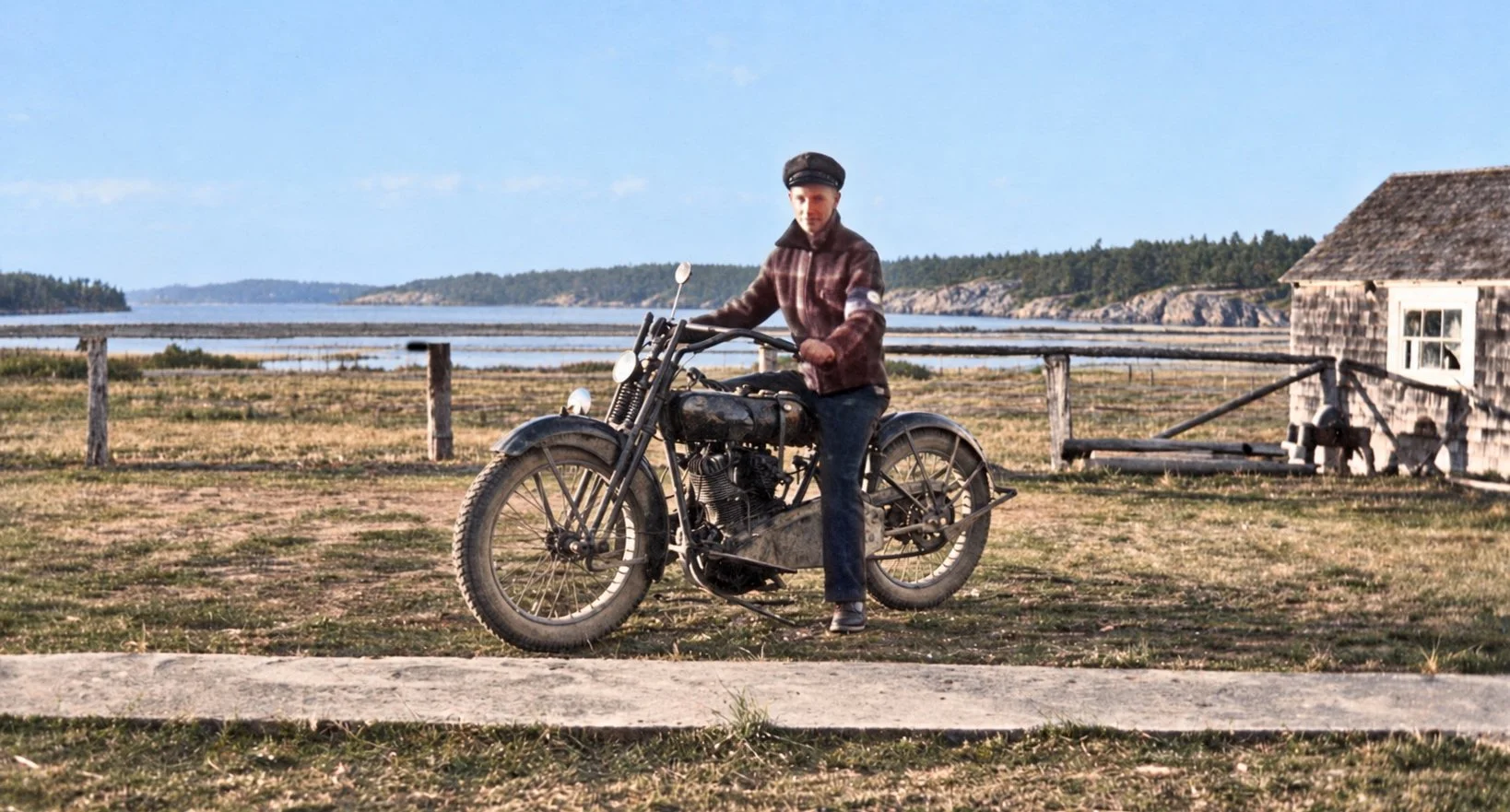
Ed Norman, 1944, Mackaye Harbor
