

Some machines become so famous that we forget they were ever machines at all.
That is what happened to the Spirit of St. Louis. Most people recognize it before they know much about it: the long silver airplane, the engine cowling covered in swirls with the name painted across it. They know Charles Lindbergh flew it alone from New York to Paris. Even people who can’t name the year understand that something changed when he landed.
The story has acquired the smoothness of a legend: airplane, pilot, ocean, triumph. But legends are what events leave behind after uncertainty has been rubbed away. The Spirit began as wood, fabric, steel tubing, wire, fuel, oil, and decisions made by people who did not know the ending.
Before it belonged to history, it had to work. To understand why one modern builder devoted years to making it live again, we must remember what the airplane was—and what the world became after it crossed an ocean.
In 1927, the Atlantic was not merely the distance to be crossed. The ocean entered the design before the airplane reached the coast, present in every gallon of fuel, every omitted convenience, every pound removed, and every risk accepted.
The Spirit was a Ryan NYP (its designation derived from New York to Paris) created specifically for Lindbergh’s attempt to win the $25,000 Orteig Prize for the first nonstop flight between the two cities. It was not simply a familiar Ryan airplane with more gasoline poured into it. Chief engineer Donald Hall and the Ryan crew designed a substantially new aircraft around an extreme fuel load, a single pilot, and one purpose.
The contract was signed on February 25, 1927. The airplane first flew on April 28, roughly sixty days later. Hall spent an estimated 850 hours on engineering while the shop devoted approximately 3,000 hours to construction. More than thirty-five people worked on the project inside Ryan’s converted fish cannery in San Diego. The ocean would eventually inspect every choice they made.
The result was an airplane of startling compromises. Its one-piece wooden wing stretched forty-six feet—ten feet farther than the wing of a Ryan M-2—and was built to lift an aircraft weighing about 5,250 pounds at Atlantic departure. Of that weight, 450 gallons were gasoline. The fuel was divided among five tanks arranged in the wing and fuselage. The largest stood directly in front of the cockpit.
That arrangement helped keep the airplane balanced as fuel was consumed and put the pilot behind the tanks in a crash. It also eliminated the windshield. Lindbergh saw the world through side windows and a retractable periscope that was less useful than its fame suggests. On the ground and during landing, he sometimes turned or slipped the airplane sideways simply to see ahead.
Ahead of him was one Wright J-5C Whirlwind radial engine. Other Atlantic teams favored multiple engines and larger crews. Lindbergh believed additional engines meant additional opportunities for failure and consumed weight better given to fuel. He chose one engine with strong endurance testing behind it and accepted the oldest bargain in aviation: if it stopped, gravity would not care about his reasoning.
These choices did not make the Spirit primitive. They made it ruthlessly particular. Every pound had to defend its presence. Comfort, stability, visibility, and redundancy were exchanged for range. The fuel that made the journey possible also hid the way ahead.
At 7:52 on May 20, 1927, Lindbergh began his takeoff from Roosevelt Field on Long Island. Rain had softened the ground into wet sandy clay. The wind had shifted into a light tailwind. The Whirlwind was turning below the expected speed, and the airplane had never flown at its complete Atlantic weight.
It gathered speed reluctantly. Men pushed on the struts at the beginning of the roll. The wheels struck ruts, lifted, and touched again. Near the boundary of the field, the Spirit finally remained in the air and passed over telephone wires with little room to spare.
Then Lindbergh flew east, and everything familiar began falling away behind him.
For the next 33½ hours he had no radio, no navigator, no autopilot, and no one to relieve him at the controls. Fog erased the horizon. Ice formed on the airplane. He climbed, descended, watched the waves for evidence of wind, managed five fuel tanks, monitored the engine, and tried to hold a calculated course across an ocean that offered almost nothing by which to check it. Fatigue did not arrive as one dramatic collapse. It stole moments. It altered perception. It made his own senses another unreliable instrument he had to monitor.
The Whirlwind kept running.
On the evening of May 21, Lindbergh found Paris and searched for Le Bourget, an airfield not marked precisely on his chart. What appeared to be factory lights proved to be automobiles trapped in the immense crowd. He circled, examined the dark landing area, side-slipped, and landed after more than a day without sleep.
The crowd reached him before the flight had fully become history. People swarmed the airplane, tore fabric, and pulled at parts for souvenirs. Lindbergh was carried away. The machine that crossed the Atlantic intact needed repairs within minutes. Before history could preserve the Spirit, the public had begun to change it.
Lindbergh had made the first nonstop solo flight from New York to Paris. The record and prize were only the most visible consequences. The flight demonstrated range, reliability, navigation, and endurance to a public that still associated aviation with war, airmail, barnstormers, and risk.
Lindbergh and the Spirit returned to the states aboard the USS Memphis. On July 20, he began a ninety-five-day national tour, visiting eighty-two cities in all forty-eight states. Tens of millions saw the airplane and encountered aviation not as a newspaper marvel but as something capable of arriving in their community.
Records are tidy. Consequences are not. The tour urged cities to build airports and the public to imagine aviation as infrastructure rather than spectacle. License applications, passenger confidence, investment, and airport planning rose. The “Lindbergh boom” did not create commercial aviation, but it gave a future already being built a sudden and intense public belief.
Across the United States, communities reconsidered their airports and their place in a world that now seemed smaller. The flight had made both the airplane and its possibilities desirable far beyond the country that produced it.
During the following year, the Spirit flew across the United States, Mexico, Central America, South America, and the Caribbean. Flags accumulated on its cowling. Fabric was repaired. Oil, dirt, weather, crowds, and ordinary operation changed its surface. On April 30, 1928, Lindbergh delivered it to the Smithsonian Institution. Its flying life had lasted about a year.
The Smithsonian saved an astonishing amount of the aircraft that crossed the Atlantic. Saving it also transformed it. Suspended above generations of visitors, the Spirit became beautifully visible and physically remote. Its propeller was still; its dangers had passed. An icon can be admired for a lifetime without revealing how it felt to build, maintain, or fly the machine inside it.
That unanswered part of the story is where John Norman entered.
John Norman is my father. That sentence changes my distance from this history, but it does not simplify it.
He grew up on Lopez Island, Washington, where a broken thing was a question rather than a conclusion. His father, Ed, could repair nearly anything. John learned to infer how objects worked and make what he could not buy. The Navy turned that instinct into a profession in aircraft maintenance. Later, he built and flew his own airplanes.
For years he wondered whether the Spirit of St. Louis could truly be built again—not as a convenient look-alike or a motionless tribute, but as a working reproduction faithful enough to reveal what the original design demanded of its builders, mechanics, and pilot.
On April 28, 2012—eighty-five years to the day after the original airplane’s first flight—John began the build in earnest.
At first, he expected reasonable substitutions, including a modern engine. Then he met researcher Ty Sundstrom, whose more than thirty years of Ryan study changed what seemed possible. Ty supplied construction photographs, measurements, diagrams, parts, and warnings about the plans.
History left no perfect instructions. Better evidence could make yesterday’s certainty useless. Early drawings placed the rear fuselage two inches too high, so John cut apart completed work. He kept many rejected pieces in a room that became an archive of labor honestly done and no longer usable.
Access to the original Spirit changed the project again. In 2015, John, his wife Heather, Ty, and Smithsonian staff examined the iconic plane while it was lowered for conservation. They traced the rudder, measured the instrument panel and cowling, tested a concealed wingtip reinforcement with a magnet, and fed a borescope through existing openings beneath the fabric.
Small errors carried large consequences. The motor mount was about an inch too long. The panel was an inch too short and two inches too high. Each elevator lacked ninety-eight square inches. The cowling’s jeweled pattern was off by half an inch. John remade what the original had disproved.
The borescope found a fresh-air system, a fuel-tank patch, and a pair of paint-covered pliers beneath the floorboards. Their position and Ryan paint suggested they belonged to the airplane’s working life. Later, the reproduction suggested why pliers might have been kept nearby: fuel pressure made its valves difficult to turn by hand.
This was the project at its most revealing. The surviving artifact preserved the tool. The working reproduction suggested the need for it. Neither could tell the full story alone.
Authenticity is easy to claim and difficult to practice. For John, it meant allowing the surviving airplane to correct him, even when the correction cost months of work.
He chose to reproduce the Spirit as it survives in the Smithsonian—not as an imaginary factory-fresh machine frozen on the morning before the Atlantic flight. That meant copying the evidence of its whole flying life: replaced rear fabric, repairs, patches, sagging components, worn floorboards, discolored hardware, flags, grime, and damage accumulated during Lindbergh’s year of operation.
This made authenticity harder, not easier. John had to build new parts correctly, then make them look used without making them unsafe. He nickel-plated and painted controls, then removed paint to match the original wear. He scuffed fresh floorboards, reproduced delamination on the panel, and formed a shallow sag where people once climbed onto the cowling. The rear fuselage was linen stitched to cotton because the airplane repaired in Paris no longer had one continuous covering material.
The hidden work went as far: boat-cut stringers tied with cord and sealed with shellac, braided cable ends, leather-wrapped lines, and wood inside steel trailing edges. John made five fuel tanks sealed with roughly eighty pounds of solder, using fire-heated irons when modern tools could not hold enough heat.
He acquired and rebuilt a Wright J-5 Whirlwind. Unavailable parts had to be made. Valve seats and guides were replaced. Molten Babbitt was spin-cast into a master rod bearing on John’s lathe. Period instruments had to work while retaining their aged faces. A professionally made $3,200 wicker seat looked wrong, so John learned the craft and made another.
Authenticity did not mean copying every danger. A removable tailwheel made an airplane designed for grass manageable on pavement. The purpose was not to turn the calendar back, but to preserve the original’s meaningful demands: blind cockpit, unstable handling, fuel system, controls, radial engine, no brakes, and constant need for the pilot’s attention.
On July 28, 2019, test pilot Ron Fowler lifted the reproduction from Arlington Municipal Airport. John watched someone else carry every weld, fitting, correction, and unresolved doubt into the sky. The Whirlwind ran roughly. Inspection revealed a cracked piston associated with a front thrust-bearing problem. John replaced the damaged components and reinstalled the original bearing.
The failure was not an embarrassment to be hidden. It was knowledge, and knowledge was what the first flight had been for. A machine that had existed in drawings, photographs, measurements, and one man’s workshop had begun answering back.
The airplane ultimately logged a little more than forty-two hours, returned over Lopez Island, and flew public demonstrations. From the proper angle, the Northwest became an ocean. The knowledge recovered through building and flying—fragile, specific, and gathered at enormous cost—is part of what this book preserves.
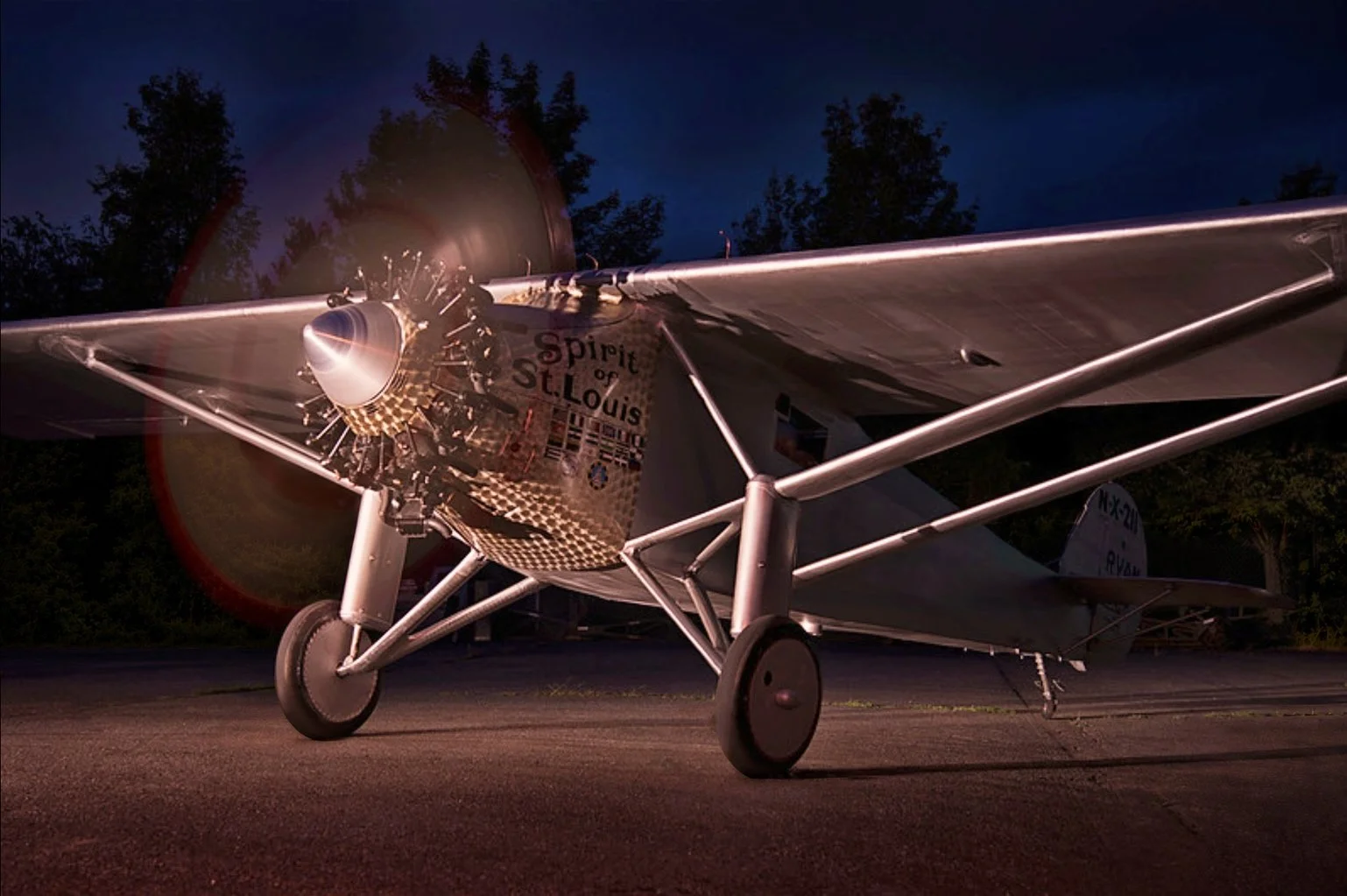
Photo Credit: Kris Hull
The forthcoming book tells the two histories together—not because Charles Lindbergh and John Norman performed equivalent feats, and not because a modern reproduction reenacted the Atlantic crossing. The stakes, risks, and consequences were profoundly different. The connection lies in the making.
The urgency is personal. After my grandfather Ed died, my uncle spoke not only of losing a man, but of losing everything that man had known. Years later, my mother recognized the same danger in John’s accumulated knowledge. Memory can vanish while the objects it explains remain. This book exists to keep one such store from disappearing unrecorded.
The Ryan team had to design and build an airplane for a flight no one had yet completed. John had to recover enough vanished knowledge to understand how that airplane had been built, changed, repaired, and operated. The questions meet in the material: fuel tanks, wing ribs, soldered seams, control cables, instruments, engine parts, patches, stains, and decisions concealed beneath silver fabric.
Thanks to everything learned through John’s efforts, the book delivers the famous story with its uncertainty restored.
The book does not treat history as a cabinet of polished legends. Records conflict. Memories disagree. Evidence answers one question and creates another. Where certainty ends, the narrative says so. Readers will see not only what John learned, but how—and why some mysteries refuse to be solved.
Aviation enthusiasts will find the machine returned to life without being buried beneath jargon. Builders, restorers, and mechanics will recognize the intelligence of materials and the cost of cutting apart finished work. General readers will find ambition, risk, collaboration, family, obsession, and the fear that what experienced hands know may disappear when those hands are gone.
Above all, the book will alter the way readers see the Spirit of St. Louis. The airplane will no longer be only a silver silhouette hanging safely above a museum floor. Its wing will carry weight. Its engine will shake the structure. Its blind cockpit will become a cramped workplace in which every task competes for the attention of one exhausted pilot.
The original made history. John’s reproduction helps us feel how difficult that history was to make.
For anyone who has looked at the Spirit of St. Louis and wondered what it took to build, fly, preserve, and finally understand it, this book offers the long answer—the answer hidden inside the airplane.
Watch for “Two Spirits, One Sky” to be released tentatively May 20, 2027 (100 years to the day after the original flight).
