

There were a number of acceptable ways to meet Elvis Presley.
You could have bought a ticket to one of his concerts. You could’ve worked in the entertainment business. You could have been introduced by a mutual acquaintance, assuming you had the sort of acquaintances who routinely said things like, “Oh, by the way, have you met Elvis?” You could maybe even have stood outside his house, waved politely, and hoped that the man who had made a career out of being recognized by strangers was in the mood to recognize one back.
John Norman came about as close to meeting Elvis Presley as a man can come without actually doing it. He stood on the property. He saw the house. He spoke to a man standing beside a gleaming black Lincoln. And then, when the answer he had been hoping for appeared in a doorway, John performed the one act that seemed absolutely sensible to him at the time.
He left.
To understand how this happened, you have to understand that getting to Graceland was not even the day's original objective.
They were trying to get to Nashville.
This is an important distinction. Nashville and Memphis are both in Tennessee, and there is a perfectly respectable road between them. There is no need to involve Arkansas. Arkansas does not feature in the standard directions, the scenic directions, or even the directions you would give someone you didn't particularly like. Yet Arkansas became an essential part of the trip, largely because John and his friend Snurd had devised their own system of navigation.
The system consisted of enthusiasm, beer, and almost no attention to where they were going.
It was not a particularly sophisticated system.
But then, neither were they.
----
John was stationed at the naval school in Millington, Tennessee, outside Memphis. He had already made it through boot camp, which had taught him a good many things, most of them involving marching, sweating, and the consequences of laughing when somebody with more stripes was not in the mood to find something funny.
Military life had begun to open up for him, though not quite as much as a civilian might imagine. There were classes, formations, inspections, and the steady institutional insistence that young men travel in groups for reasons that had nothing to do with efficiency.
John had found a way around one particular inconvenience. He bought an Austin-Healey Sprite, a small British sports car, and parked it along the route his company marched to school. He and a friend could fall into formation with everybody else, proceed a respectable distance, then quietly peel away and drive the rest of the route.
It was a beautiful solution to a stupid problem. The Navy wanted everybody to arrive at school together. John wanted to arrive at school without walking a mile and a half. These were not incompatible objectives unless one insisted that obedience was itself the point of the exercise.
The Sprite also gave him access to Memphis and all the things Memphis had to offer a young sailor who had grown up on Lopez Island. There were streets and alleys and bars and unfamiliar people. There was noise, possibility, temptation, and the thrilling suspicion that an entire city might be operating without the knowledge or permission of his parents.
And there were friends.
One of them was named Duane, although that name turned out to be terribly inconvenient because there were two Duanes in the group. They had therefore been assigned substitutes. One became Doc. The other became Harry, and then, somehow, Snurd.
John himself was Trogg, short for Troglodyte.
This is a fine illustration of how male friendship works in certain stages of life. You meet a guy, discover his name, spend a little time getting to know him, and then decide his name is unacceptable and replace it with a noise that sounds like a plumbing problem.
John and Snurd became close friends. This was perhaps inevitable. Each possessed qualities that the other admired, especially a willingness to treat an ill-considered suggestion as the beginning of an adventure rather than the end of a conversation.
On a particular weekend, the two decided they wanted to see Nashville.
Nashville was a perfectly reasonable destination. It had a reputation for music. It was somewhere they hadn't been. It would offer a change of scenery and, with luck, interesting things to tell people back at the barracks.
They loaded two cases of beer into the Sprite, lowered the top, and headed off.
If you are unfamiliar with the Austin-Healey Sprite, picture a small sports car that seems to have been designed around the dimensions of two fairly optimistic men. The idea of adding two cases of beer does not improve the accommodation so much as turn the automobile into a delivery service with occupants.
But the day was theirs, the roof was down, and the open road lay ahead.
They began drinking their beer.
As they finished the beers, they tossed the empties behind the car.
This, apparently, seemed like an excellent system. Why burden a vehicle with the weight of containers that had already served their purpose? The countryside was enormous. It had room for a few more pieces of metal.. Nature could probably handle it. Nature handled volcanoes, didn't it? Nature could handle a beer can.
Of course, there was a rather significant distinction between a volcano and two sailors deliberately throwing trash onto the highway. Volcanoes are not generally issued driver's licenses.
John later acknowledged that drinking and driving was dangerous then, just as it is now. What had changed was the way people and authorities responded to it. In that time and place, he remembered, it was distressingly common and could be tolerated. Littering, meanwhile, had acquired a reputation as a public offense.
It was a remarkable arrangement of priorities. You could be incapable of driving in a straight line, but for God's sake don't make the roadside untidy.
Society has always been good at that sort of moral bookkeeping. We assign a different official to every problem, give each official a little piece of the universe to protect, and then act surprised when the pieces don't fit together. The highway is supposed to be safe, clean, orderly, and accessible to people who apparently cannot tell which direction they're traveling.
John and Snurd had an additional difficulty.
They were driving the wrong way.
Not the wrong lane. Not the wrong side of a one-way street. Nothing that immediately announces itself with horns and screaming. They were going in the wrong geographic direction, which is the most deceptive kind of wrong. Everything looks normal. The road stays beneath you. The engine runs. The scenery changes. You can travel a considerable distance in a perfectly orderly fashion while accomplishing precisely the opposite of what you set out to do.
That is a useful talent if your intention is to be lost.
They did not notice their mistake.
They did not notice, apparently, that Tennessee had ended.
They crossed into Arkansas.
And then an Arkansas state patrolman noticed them.
----
There are few situations that inspire immediate and sincere respect for authority quite like seeing a police car's lights in your rearview mirror when you know you've been doing several things you shouldn't have been doing.
The mind undergoes a rapid conversion. A minute earlier, authority is an annoying collection of regulations devised by people who don't understand how to have a good time. A minute later, authority is a fine and noble concept. You would like to thank authority for its service. You would like authority to have a pleasant afternoon. Most of all, you would like authority to go away.
John was frightened. He knew they had been drinking. He knew they had been throwing their empties onto the highway. He was reasonably certain that whatever the officer wanted to discuss, the discussion was not going to improve his weekend.
Snurd had an additional reason to be nervous.
He had marijuana with him.
John didn’t know this until they were stopped. So while John was mentally reviewing the offenses he could remember, Snurd was reviewing one John had not yet been informed about.
It is difficult to present a calm, reassuring face when you're carrying a secret that could make the situation considerably worse. And Snurd, by John's account, was shaking.
The patrolman took their licenses.
Imagine, if you will, the officer surveying this scene. Here was a little open-top sports car containing two young servicemen and the remains of a substantial beverage operation. Somewhere behind it lay a trail of empties, the evidence of a mobile party whose chief contribution to the landscape had been to make it less attractive. The occupants were supposed to be going to Nashville. Instead, they were in Arkansas.
There is a point at which a professional who encounters a situation like this must wonder whether issuing a citation will adequately describe the problem. The paperwork has boxes for various offenses. It seldom has one marked “GENERAL FAILURE TO UNDERSTAND WHAT IS HAPPENING.”
According to John's account, the patrolman chose a solution that was startlingly straightforward.
He told them to turn around and go back to Tennessee.
He would let them go this time, he said, provided they promised not to return to Arkansas.
They promised.
Without hesitation.
This was an easy promise to make. They had never wanted to visit Arkansas in the first place. Arkansas had been a clerical error committed at highway speed. Being told to stay out of it was not much of a punishment. It was the first useful navigation advice they'd received all day.
The officer wasn't entirely finished with them. He followed the Sprite to the Mississippi River bridge. There he stopped them again, returned their licenses, and repeated the warning that they were not to come back.
One can understand the precaution. The first time these guys had been given freedom and a set of roads, they had managed to end up in the wrong state. There was no guarantee that merely pointing them toward Tennessee would solve the problem permanently.
The Mississippi marked a boundary a man could recognize. It was a large, unmistakable feature of the continent. It divided one state from another with a body of water so substantial that even John and Snurd were unlikely to miss it.
The patrolman had now made his intentions clear. They were to cross the river, continue toward Memphis, and under no circumstances reappear in his jurisdiction.
There is something wonderful about being thrown out of a place you never meant to go. It's an unusually efficient insult. You arrive by mistake; the authorities look you over; and the state itself asks you not to make that mistake again.
John and Snurd were happy to oblige.
They crossed the bridge and returned to Tennessee.
They had set out for Nashville. They had reached Arkansas. They had been officially discouraged from returning.
By any ordinary standard, the outing had already been a failure.
Fortunately, ordinary standards weren’t governing the outing.
----
Once they were safely headed toward Memphis, Snurd revealed another piece of the day's entertainment.
“Here! Try this!” he said.
He handed John a joint.
Until that moment, John had never tried marijuana. He was reluctant at first. That was a sensible reaction, although sensible reactions had not exactly dominated the day's decision-making.
He took a puff.
He remembered feeling more out of touch than he had ever felt before.
Now, there are people who would tell this part of the story as a charming portrait of youthful freedom, and there are people who would turn it into a sermon about moral decline. Both approaches give the participants rather more credit than they deserve. What you had, in practical terms, was a driver who had already been drinking, a passenger who had concealed marijuana from him, and a situation that had passed well beyond the stage where anybody should have been making decisions about transportation.
They should not have been driving.
John said as much later.
What they decided instead was to continue drinking the beer they had left and go find Elvis’ house.
This was a new goal, and it had one enormous advantage over the previous one: the house was actually in Memphis.
Elvis had been on John's mind. During the preceding week he'd listened to a Memphis radio broadcast from the barracks, and Graceland had become something he wanted to see. He was curious about where the famous singer lived and what the place looked like.
In a more conventional story, that curiosity would produce a daytime visit to a famous landmark, perhaps a photograph, and then a return to base.
But Graceland was not merely a landmark. Elvis was alive and living there, and the estate was his private home.
John and Snurd were about to discover that the difference between a famous place and someone's front yard is not erased just because the owner has made a lot of records.
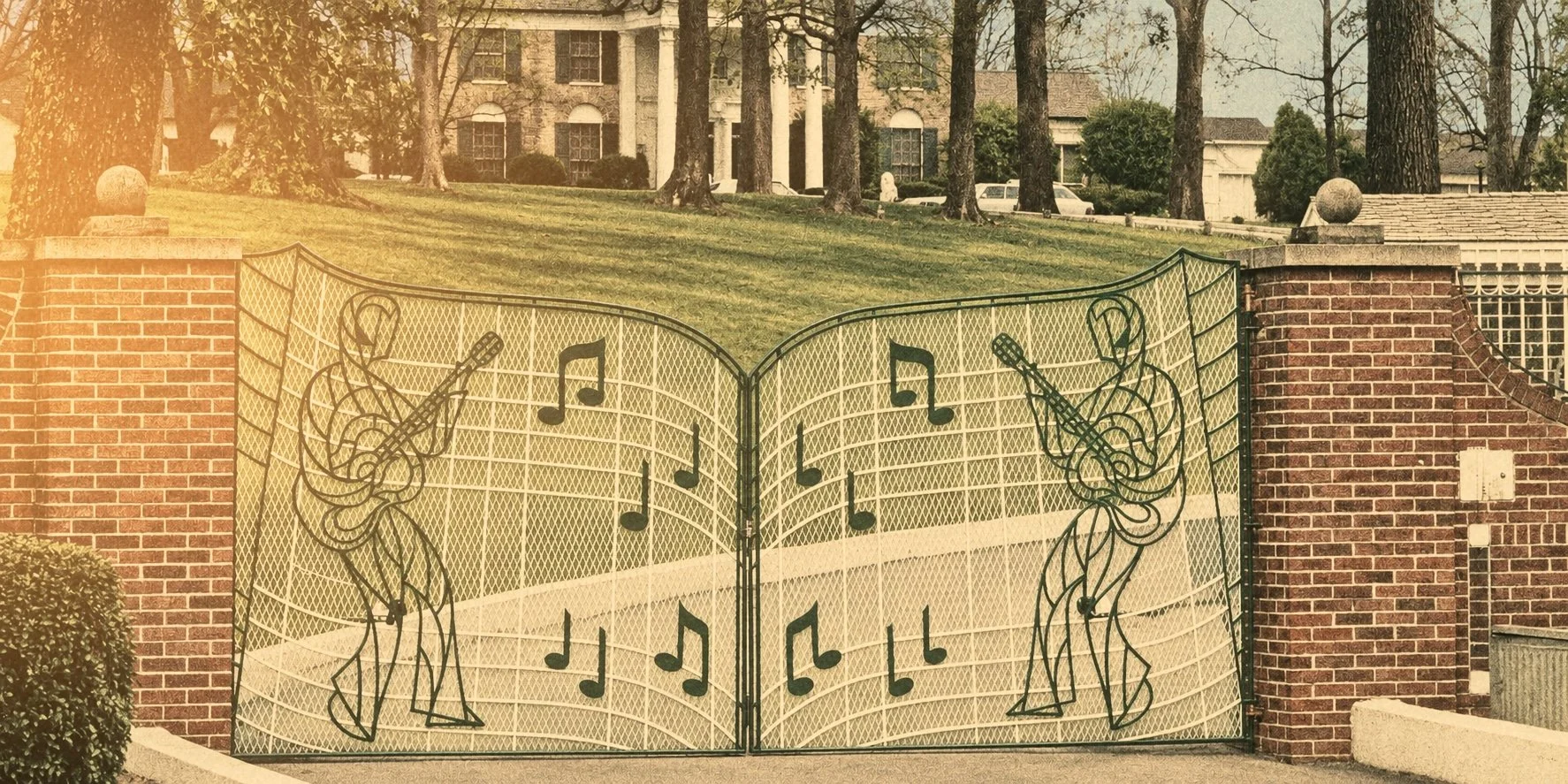
They drove toward the house and when they arrived at Graceland, the gates were closed.
This was not surprising. Gates are usually closed for a reason. Their main function is to separate the people who belong inside from the people who don't. There is no sensible interpretation of a closed gate at a private residence that means, “Please come in and see if the owner is available for conversation.”
John noticed three or four women in the yard, playing a game with lawn darts. They seemed at home there. He did not know who they were.
Snurd got out of the Sprite and walked up to the gates. He peered through, hoping for a better look at the property.
Then the gates opened.
Neither man had expected that.
Snurd went in.
The gates closed behind him.
And John began to laugh.
Of course he laughed. From John's point of view, the gate had just swallowed his friend. Snurd had approached the entrance as an ordinary curious bystander, been admitted for reasons nobody understood, and then had the exit shut behind him. It looked less like a visit to a celebrity's home than the beginning of a very expensive practical joke.
There is a particular kind of laughter reserved for seeing your friend become the victim of a predicament you have not yet realized is also your own.
John enjoyed that laughter for a little while.
Then he went up to the gates himself, hoping to find a way to get Snurd out.
The gates opened again.
John walked through.
The gates closed behind him.
Now there were two idiots inside Graceland.
If someone had been keeping a scorecard, the property was winning.
----
The driveway curved toward the house. John and Snurd followed it, because once you have walked through the gates of Elvis Presley's home, there is an odd pressure to behave as though you had meant to be there all along.
This is one of the stranger impulses of human behavior. People who would never dream of invading a stranger's house can find themselves in a place they don't belong and suddenly become determined to look like competent visitors. They walk with purpose. They look around politely. They try to avoid the embarrassing admission that they have no business being there.
John and Snurd were neither sober enough nor knowledgeable enough to produce a convincing explanation for their presence. Still, the gates had opened. Twice. Whatever that meant, it seemed to have given their feet permission to keep moving.
Near the house stood a jet-black Lincoln. A man was polishing it.
John remembered the car's shine and the man working beside it. He was black, and he seemed to know the property well enough to be at ease there. He did not appear to share John's astonishment at being in the driveway of Graceland. From the man's perspective, it was probably just another day at work.
John, in contrast, was having a day he would eventually recount for decades.
He approached the man and asked a question that, under the circumstances, was almost impressively innocent.
“Does Elvis ever come around here?”
It's a lovely question, partly because the answer seems to be contained in the name of the place. A visitor to the White House could ask whether the president ever dropped by. Someone standing in a dairy barn could ask whether cows were known to frequent the premises. But John had not come with a formal plan for meeting the King. He'd come to see where Elvis lived, but now that he was actually inside the gates, some part of his brain apparently required confirmation that this was not merely a property associated with Elvis in the abstract.
The man looked at John strangely.
He turned his head toward the house.
“He's right over there!”
John looked up.
And there, standing in the doorway of Graceland, was Elvis Presley.
Not a photograph. Not a wax figure. Not a record sleeve or a poster in a shop window. Elvis himself, looking toward the two unexpected visitors who had come up his driveway.
Here, after a day full of mistakes, was an opportunity so improbable that it ought to have felt like a reward. The King of Rock and Roll was just over there. He was visible. He was close. A few moments earlier John had been asking whether the man ever showed up at his own house, and now the answer was standing in front of him.
For most people, this would be the moment when the brain produces something suitable to say.
“Hello, Mr. Presley.”
“I've enjoyed your music.”
“Sorry to bother you.”
There are hundreds of possible sentences. Some are good, some are clumsy, and some are the sort of thing a person will spend the rest of his life wishing he hadn't said. But they all have the basic advantage of involving speech.
John said none of them.
Because at almost the exact instant he recognized Elvis, another recognition arrived.
He was trespassing.
The gates were not a ticket booth. They were the entrance to a private residence. John had no invitation he could produce, no business with anyone on the grounds, and no explanation likely to sound better when spoken aloud. He had been drinking. He had smoked marijuana for the first time. He was standing on Elvis’ property with a friend called Snurd, whose presence could not possibly improve the credibility of the situation.
The encounter, which had seemed magical a moment earlier, abruptly felt like evidence in a case.
This was an unfortunate piece of timing for the return of John's judgment. His judgment had missed the decision to drive while drinking, the disposal of the beer empties, the failure to navigate to Nashville, the highway-patrol encounter, the first marijuana experiment, and the decision to enter a famous man's private property.
It finally reported for duty when Elvis Presley appeared in a doorway.
And its first official act was to declare an emergency.
John looked at Snurd.
“I think we better get out of here!”
And so they turned around.
They walked back down the driveway.
The gates opened.
They went out.
Just like that.
No great conversation. No introduction. No autograph. No photograph to show the men in the barracks, no handshake that could be described to the family back home. Not even a clumsy sentence that might have been embarrassing at the time and priceless fifty years later.
They had managed to penetrate the gates of Graceland and then voluntarily evacuate at the precise moment the reason for visiting became visible.
It was an extraordinary achievement in missed opportunity.
----
People are funny about chance encounters with famous people. They spend years wondering what they would say, rehearsing elegant remarks that are supposed to demonstrate both admiration and an appealing indifference to celebrity. Then they meet somebody recognizable in a grocery store and blurt out something about the price of lettuce.
At least those people have a sentence to regret.
John's regret was more complete. He hadn't said anything at all. He had reached the moment he'd never reasonably expected to have, and fear had carried him backward down the driveway.
What did Elvis think of the two men? Perhaps Elvis had seen a couple of curious young visitors and thought little of it. Perhaps he was wondering who had let them onto the property. Perhaps he had just stepped into the doorway at the wrong moment, leaving John with an impression of an encounter that had never truly begun.
That uncertainty is part of what haunts the story.
It would have been simpler, in a way, if someone had chased them out. A security guard, a shouted warning, an obvious order to leave—any of those would have provided an explanation. John could have gone home saying he'd almost met Elvis but was prevented by someone else.
Instead, John had been prevented by John.
That is a much more irritating person to blame, because he follows you everywhere.
Time passed. The Navy sent John on to other places and other adventures. He built a life far larger than any single afternoon in Memphis. There were people to love, jobs to do, airplanes and engines to work on, and stories enough to fill a book. Elvis died in 1977, and the possibility of ever correcting the missed meeting disappeared.
But that doorway stayed with him.
In 2002, John returned to Memphis with his wife on a business trip. It was the twenty-fifth anniversary of Elvis's death, and this time they toured Graceland as visitors, along with everybody else who had paid to enter a place whose gates John had once wandered through under dramatically different circumstances.
There is a curious indignity in returning as a tourist to a place where you once almost met the owner. The entire machinery of public visitation—admission, tours, exhibits, designated routes—exists to organize an experience that John, with a friend called Snurd and an appalling sense of timing, had nearly stumbled into for free.
During the tour, John saw a set of monitors and controls in the kitchen area. The system allowed the gates to be opened from inside the house.
And a possibility occurred to him.
Someone inside Graceland could have been watching them.
Someone could have opened the gates when Snurd came up to look, then opened them again when John approached. The gates could have been opened to let the two visitors leave.
John came to believe that Elvis himself may have watched them and deliberately opened the gates. That, he thought, might explain why Elvis was standing in the doorway when they reached the house.
Was it true?
He didn't know. He couldn't know. A set of gate controls establishes that someone inside could operate the gates, not who actually did so on a particular afternoon decades earlier. The women playing lawn darts, the man polishing the Lincoln, Elvis in the doorway—any number of ordinary details might have an explanation John never learned.
But once the idea was in his head, the old regret acquired a new and particularly aggravating shape.
What if he hadn't been caught trespassing?
What if he had been let in?
What if the man he had wanted to see was standing there not because he'd discovered intruders, but because he was willing to meet them?
John could replay the entire moment. The question beside the Lincoln. The turn of the man's head. Elvis in the doorway. The sudden panic. The decision to retreat. Somewhere in all that, perhaps, was a tiny window in which something extraordinary might have happened.
And he'd closed it himself.
----
There is no shortage of lessons people might try to extract from this adventure. Don't drink and drive is the obvious one, and it was as true then as it is now. Don't litter. Don't accept mysterious substances from a friend when you're already incapable of navigating between major American cities. Learn which way Nashville is before crossing a state line. And, for heaven's sake, don't wander onto a stranger's private property just because the stranger happens to be famous.
All reasonable advice.
John's younger self ignored most of it, and the one rule he finally decided to obey—leave a place where you don't belong—came at the single moment he would spend the rest of his life wishing he'd stayed another thirty seconds.
That doesn't mean leaving was wrong. From the standpoint of personal safety, courtesy, and common sense, walking away may have been the smartest decision he made all afternoon. A private home is still a private home, even when its resident is famous. Nobody owes strangers a conversation simply because the strangers have succeeded in getting past a gate.
But being right does not always protect a person from regret.
And this particular regret had an almost perfect comic structure. A man sets off for Nashville, is expelled from Arkansas, finds his way to Graceland, somehow makes it through the gates, and finally runs away from the person he came to see.
He encountered a state patrolman who insisted on speaking with him twice. He found a man who was happy to answer a question about Elvis. He even managed to get a reaction out of an entrance gate, three separate times.
The only person he couldn't bring himself to talk to was Elvis.
Years later, John could still picture him in that doorway.
He had wanted to meet the King of Rock and Roll.
And when the King appeared, John Norman did what any brave young sailor with two cases of beer, a British sports car, and a truly exceptional series of decisions behind him would do.
He turned to Snurd and suggested they get the hell out of there.
