

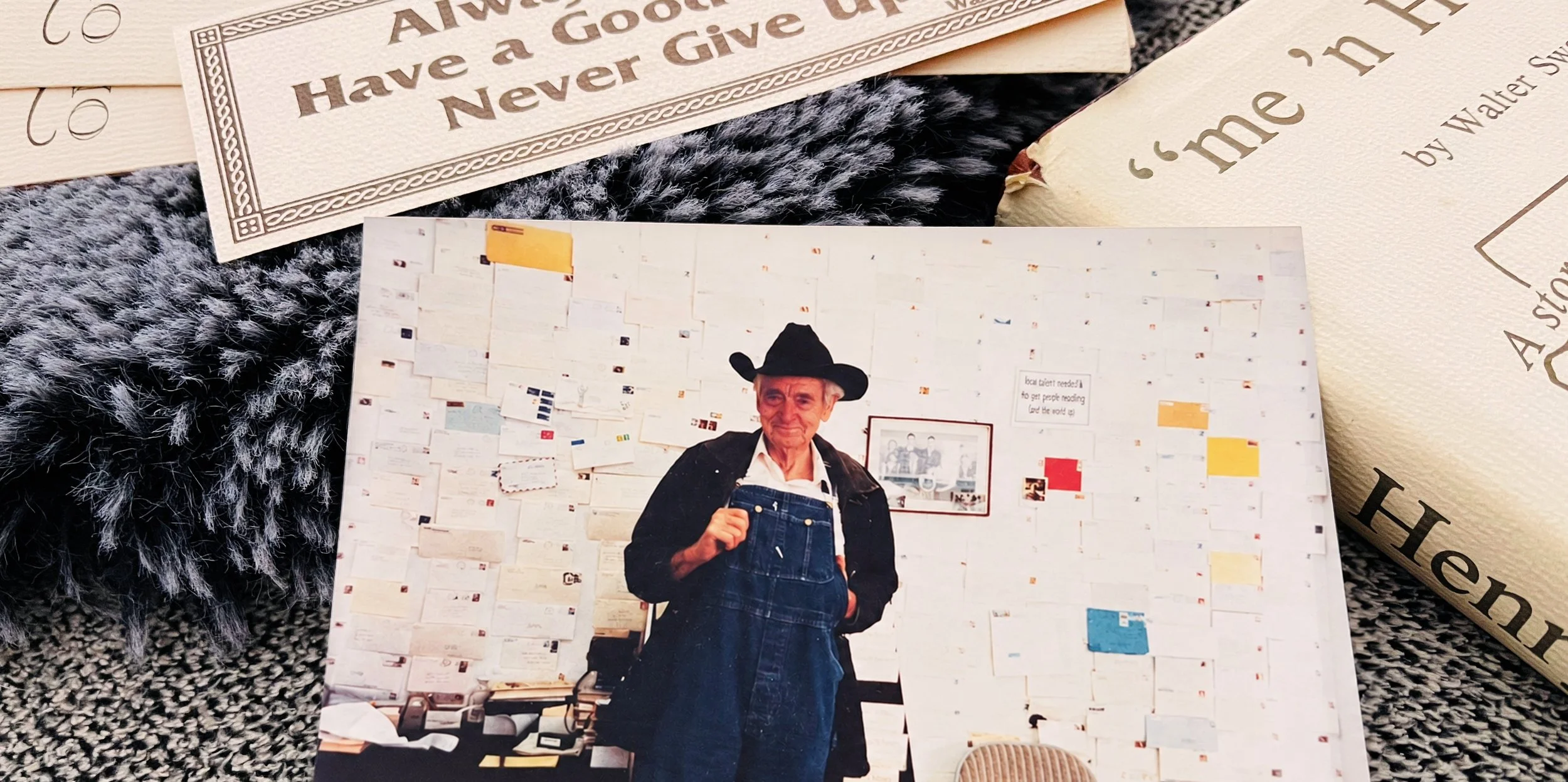
I was a cowboy before I knew Walter Swan.
My qualifications included boots, a hat, a duster, and a very generous understanding of what constituted a cowboy. I also had a hooded sweatshirt made from a Mexican blanket, which broadened the possibilities of the outfit considerably.
The decisive credential arrived at Christmas in 1991: a Red Ryder BB gun.
That settled it. There were probably other requirements, involving horses or cattle, but I assumed those could be attended to later.
My grandparents had moved from Anacortes, Washington, to Tombstone, Arizona, when I was seven. They had exchanged the wet port town for a place whose very name seemed to belong on a wanted poster. Anacortes had water, boats, the familiar gray weather of the Northwest. Tombstone had the enormous sky and the old Western promise that something interesting had happened just around the corner, possibly at gunpoint.
To a child, the move amounted to a change in the laws of nature. The landscape no longer gathered itself into the familiar green shapes. It opened. Mountains stood out against the distance instead of disappearing into the weather. The ground had colors I was still learning to associate with actual ground.
My grandfather seemed as taken with the new country as I was. The rest of the family had something of the same enchantment about them. For a while, the place had given everybody a little of a child's permission to look. My grandparents were making a home in it. I was conducting the more urgent business of becoming suitably dressed.
I remember that first Christmas of their southwestern residence as a magnificent success.
There are practical advantages to being seven. A coat can change your occupation. A hat can establish your character. A present beneath the tree can resolve the question of who you are going to be for the foreseeable future. Adults tend to require references and some prior experience. I had the boots.
This new world also brought us to Bisbee.
Bisbee had gone about becoming an old Western town in its own fashion. Mining had drawn people into the hills, and the town had fitted itself to the country they found there. Its streets and buildings went up and down as though a level surface were an agreeable idea someone had failed to order. Copper had helped make the place. By the time we came, galleries, shops, and visitors were finding other uses for the old mining town's rooms.
My grandparents took us around to see the place. Part of that visit found us standing at the edge of the Lavender Pit, looking down and across an amount of missing ground I had no sensible way to measure.
I was seven. I knew exactly what we were looking at.
The Grand Canyon.
I had heard about it, and now here it was: a hole in the earth so vast that the name seemed entirely adequate. I had never needed to consider ground on this scale before. There was the edge where we stood, and then there was all that distance, downward and away. A famous place ought to make a person feel something like this. The identification seemed sound.
The grown-ups told me it wasn't the Grand Canyon.
This was a surprising position for them to take, considering the evidence in front of us. I could look straight at the enormous hole while they were telling me. Their certainty did very little to disturb mine.
I have since accepted the distinction between a copper mine in Bisbee and the Grand Canyon. At the time, the grown-ups had brought me to a wonder of the world, and I was not inclined to let them talk me out of it.
I enjoy walking around in this memory now: They were giving me a day in a place they had come to know. I was discovering how much world there was beyond the landscape I had grown up in, and getting a little ahead of the introductions.
There was plenty to occupy a child who had recently acquired a professional interest in the West. There was also plenty to occupy the grown-ups, whose interests could remain mysterious even when they were standing quite close to me.
Downtown, we found the One Book Bookstore.
And Walter Swan.
The name of the shop made an immediate impression. One Book. An entire bookstore had been arranged around the proposition that the customer would probably like this particular book very much. There would be no need to trouble him with hundreds of alternatives.
Walter was the author. He was also the proprietor, the principal attraction, and a highly satisfactory explanation for why the arrangement worked. His usual outfit was bib overalls and a black cowboy hat. He could sit in his rocking chair in the storefront window, among copies of the book, and let the people passing on Main Street discover that the display was capable of conversation.
By the time we visited, the ordinary interests of adults had to compete with the considerable importance of being me. My grandparents had frequented this bookstore before and were obviously taken with Walter. They talked. He had stories. The encounter possessed the comfortable air by which grown people can make a new acquaintance seem, to a child, like someone they have always known.
I assumed they were best friends.
Naturally. Why else would they be talking for so long?
The possibility that a friendship could be occurring in front of me had not required much investigation. Old people knew other old people. They seemed to have been given a great deal of time in which to arrange it. My grandparents and this man belonged, in my understanding, to the same country of people who had already done nearly everything interesting before I arrived.
Walter's shop, however, was something even I could appreciate.
One Book Bookstore.
The idea was small enough to fit in my head and peculiar enough to stay there. Long after the grown-up conversation had lost its particular words, the name remained. A man had a book. He wanted people to buy it. He had therefore provided a place in which they could do so.
The whole enterprise had the lovely certainty of a child's solution, carried out by someone old enough to sign a lease.
The book was called “me 'n Henry.”
Henry was Walter's older brother. The stories concerned the boys growing up on their family's homestead in Cochise County, with the accidents, animals, inventions, misunderstandings, and occasional triumphs that childhood can supply when it is allowed enough years to become a story.
Walter had been born in 1916. Long before the black hat became recognizable to tourists, he had been a boy whose family did not have much money. His overalls acquired patches on top of patches. School was difficult. Other children could be unkind. Arizona's old days had made demands that no new cowboy outfit was going to satisfy.
The country I found captivating had been the place where he and his family needed to find enough to live on. The dust and distances had occupied ordinary days, with ordinary appetites to be fed. His West contained work, embarrassment, ingenuity, and a brother close enough to keep appearing whenever the story was told.
Walter grew up and became a plasterer. He knew how to finish a wall, how to put material where it belonged and work it into the surface the job required. For much of his life, that was the skill by which he supported a family.
He and his wife, Deloris, had eight children.
In the evenings, his boyhood could be brought out for them. Near the fireplace, before bedtime, there were stories about Walter and Henry. A father who had spent the day working with his hands could bring the children to the old homestead through the things he remembered happening there.
There was a Model T. There were goats, cows, bees, the sort of creatures that can become indispensable to an account of how something went wrong. A billy goat ate his first-grade reader. A boy got his finger stuck in a car. The world of children and the world of adult intentions repeatedly met and discovered that neither had understood the other's arrangements.
The children wanted the stories. Deloris thought he ought to write them down.
So he did.
For years he put his memories onto paper. He wrote in longhand and learned to peck out words with two fingers on a typewriter. The man who could plaster a house had another kind of surface in front of him, and the marks he made there required help of their own.
Deloris supplied it.
She had studied English and business. She edited, corrected, typed, and arranged. Walter's voice had to make the journey from a family's evening into sentences a stranger could follow. She helped it find its way.
The stories accumulated in an apple box.
Pages had been added to pages until a container meant for something else held enough of a man's life to become a book. The box could sit quite ordinarily in a house while containing a brother, a homestead, a succession of animals, and children who had grown older while the pile increased.
One more story went in. Then another.
Eventually Walter and Deloris began sending the manuscript to publishers.
An envelope could leave Arizona carrying all that confidence. It would travel east into offices where books were considered and futures occasionally authorized. Walter would see a publisher's letter in the mailbox and become excited. Perhaps this would be the one.
The answer was no.
Then another publisher's answer was no.
The Swans kept sending. Letters kept returning. The accounts of those years have a weary sameness about them: a manuscript prepared, a possibility imagined, another explanation of why the possibility would not be happening.
Deloris remembered responses describing the stories as folksy and then declining to believe that anyone would pay to read them. Walter eventually paid a literary agency for help and received a lengthy explanation of why the book would not sell. His childhood had acquired a surprising number of people prepared to forecast its commercial future.
At home, the manuscript still existed.
So did the two people who had made it.
They bought a computer and a laser printer. Deloris learned the machinery. A different keyboard now stood between the apple box and the finished book, and she spent the time required to make it useful. The work involved preparing pages, arranging the text, returning to a problem until the copy could be sent onward.
The finished object was becoming less dependent on a stranger saying yes.
Walter had made Deloris a promise: if she could get the stories into book form for publication, he would buy her an organ. She was a pianist and organist as well as the person wrestling his sentences into order. The promise gave the work another possible sound at the end of it.
They paid to have the book printed.
Money came from the family's own resources and borrowing. When larger orders followed, they mortgaged their house to help pay for the books. Paper had weight now. There were covers, pages, copies that could be opened, held, stacked, put into a car. The stories had crossed the distance between something a couple believed in and something that occupied space whether anybody bought it or not.
Walter was overwhelmed when he first saw the book in print. He could talk readily about almost anything else; this left him struggling for words.
For once, the story could be held in his hands before he had found a way to tell it.
He put books in the trunk of his car and began taking them around southern Arizona. Gift shops, bookstores, libraries: here was a man with copies to sell and a very direct interest in finding someone to sell them to. He went to signings. He talked to people. The book could leave the trunk and enter another household, where Walter and Henry might be introduced to a family neither brother had met.
Sales came. The shops wanted their portion of the price. Walter began considering how much of the business he could do himself.
There had to be a better way.
In the old J. C. Penney building on Main Street in Bisbee, there was space to rent. A small storefront could be had for a hundred dollars a month. Walter could put his books there and sit beside them.
Another bookstore was nearby, which Deloris considered a fairly obvious reason to question the plan. The other store had a larger variety of books. It had already arranged itself to receive the sort of person who might be persuaded to buy one. Walter's intended competition had the advantage of being a bookstore in the commonly accepted sense of the word.
Walter opened his anyway.
He had spent years writing the stories, more years trying to have them published, and still more effort getting the finished books into people's hands. Opening a shop was simply the next thing the problem appeared to require.
He called it the One Book Bookstore.
A table could support a pile of copies. Folding chairs could receive customers. The window could announce the proposition to Main Street. There was very little room for uncertainty about what a person was going to find inside, though Walter himself supplied enough conversation to make every visit less predictable than the stock.
He liked to tell how he had sold enough books in the first fifteen minutes to cover a month's rent.
After all those letters explaining why the book would not sell, the quarter of an hour must have been particularly agreeable.
The shop acquired evidence of its unlikely existence. A report card displayed the poor grades of the boy who had become its author. Rejection letters could be shown to people standing beside the book that had survived them. Walter gave these old judgments places where they could continue doing a useful job: entertaining his customers.
A visitor could consider the schoolwork, the publishers' opinions, and the books piled within reach. All the exhibits were available in the same small space.
Walter signed copies. Sometimes spelling continued to offer him difficulties even when the text required was only a customer's name. The transaction generally survived. The person buying the book had come into possession of a story about acquiring it, which seems to have been part of the service.
He could recognize a potential reader in the course of an ordinary walk through town. Somebody at a lunch counter might discover that the conversation now concerned whether he had bought Walter's book yet. People knew him. Visitors learned who he was. The black hat and overalls kept appearing where the books could be mentioned.
Inside the shop, the chair rocked.
There is a beautiful absurdity in putting the author in the window. A display is generally expected to remain quiet while the customer makes up his mind. Walter could look back. He could greet somebody, tell a story, invite the passerby into the business of finding out who had written all those books with the same title.
The customer might have set out that morning with a perfectly reasonable intention of buying no books whatsoever. Then there was a man in a chair, and the man had a brother named Henry, and before long the customer was providing the name that ought to go inside the cover.
Walter enjoyed the people. Some wanted to discuss his writing. Others simply wanted to talk. They had their own stories to bring, and the author who sat among his boyhood adventures could spend part of his day listening to someone else's.
Letters arrived from far away. The walls filled with messages from people whose lives had crossed the shop's small patch of Main Street. The manuscript had once traveled in search of permission; now its author received mail from readers who had already made up their minds.
Henry sometimes minded the store. A person could therefore arrive looking for a book about two boys and find one of the boys, considerably older, keeping an eye on the stock. The title had become available for conversation in more than one body.
Deloris managed the business. She had helped get the stories into print and continued helping the printed stories get where they were supposed to go. The shop's charm depended on a considerable amount of work that did not take place in the rocking chair.
And Walter bought her the Hammond organ.
I am glad the promise reaches that part of its story. Amid all the practical risks, someone had remembered the music. The pages became books, the books found readers, and the woman who had spent years helping them take shape received the instrument he had said she would have.
By 1990, thousands of copies had sold. People beyond Bisbee began hearing about the retired plasterer whose solution to publishing trouble had been to open a shop devoted to his own work.
He appeared with David Letterman that June. Letterman had the book in front of him and the author beside him, and the conversation could hardly avoid returning to the fact that a bookstore had been opened to sell one title.
Walter described the history in his plain, forward-moving fashion. Nobody had wanted to publish it, so they had published it. Selling it had presented another difficulty, so he had opened the shop. In the bright, brisk world of television, the man from Bisbee could make the whole undertaking sound like a series of chores he had finally got around to doing.
Letterman asked about more books. Walter already had others written. Would that mean opening more stores?
The question was a good one.
In time, the business acquired another door and another name: The Other Book Store.
The original idea had been spared an untidy correction. Walter could have more books, and the One Book Bookstore could remain exactly the sort of thing a visitor would remember. A man capable of finding that much pleasure in a sales problem was unlikely to let success deprive him of the joke.
There was “me 'n Mama,” written with Deloris, and there were other collections, a cookbook, “Adventure Stories,” and “How to Be a Better Me.” More of the life could find its way onto paper. The little shop's name had opened a possibility large enough to need additional shelves.
National attention brought more people, more mail, more requests for signatures. Walter could be recognized before he had introduced himself. A visitor might have seen him on television and come into the store with the peculiar familiarity a screen can give a person who has never met you.
One of the things he said about his writing was that he tried to make sure people did not have a headache when they finished. It is an unusually considerate ambition for an author, and perhaps especially suitable to one who expected to encounter the reader on his way back down Main Street.
Walter's fame had a neighborhood. The man who had been on television was still sitting where a passerby could find him.
That is the place my grandparents entered.
Looking back, I suspect they recognized a kind of company that had been familiar long before they moved to Arizona. Lopez had given them people who worked with their hands, raised families, improvised answers to practical difficulties, and turned the results into stories. A person could begin describing a machine or a childhood mistake and discover that everyone else had moved a little closer to listen.
Walter had Arizona instead of the islands. His early landscape was dry country and homestead ground. Still, the ways a life could be put into conversation may have sounded wonderfully familiar. There were brothers in trouble. There were parents trying to manage. There were animals with purposes of their own, old cars, hard work, and the small disasters a family eventually learns to laugh about.
My grandparents had stories like that. Walter had made a place in which people could come and exchange them.
I wish I could go back in there and experience it through my grandparents’ eyes. At seven, I had enough curiosity to notice the name of the shop, and enough vanity to remain primarily concerned with my own part in the expedition. The adults had the advantage of recognizing a lifetime in another person's account of his day.
They could listen to Walter and supply their own memories around his words. I had only seven years to contribute, and a substantial portion of those had been spent acquiring the knowledge necessary to put on my own boots.
So they talked, and I assumed they had always been friends.
Perhaps that was my young mind's way of recognizing ease. The acquaintance had no need to present its history to me. There was a man, there were my grandparents, and the conversation had already made somewhere comfortable for them to stay.
What I carried away from the shop was the sign.
It was a kind of invitation I understood without having to know what it had cost to make it. One Book. Here. The man who wrote it could be found beside the copies, and he would be pleased to tell you about it.
The apple box, the letters, the keyboard, the printing bills, Deloris's hours at the work: those were behind the encounter. As a child, I could see only the completed trick. It was like finding a rabbit in a hat and being very pleased with the rabbit. I had little interest in the years someone had spent learning to put it there.
Now the years interest me.
So does Deloris, whose name did not have to be on the glass for her work to fill the place. Walter knew how much of it she had done. When attention came his way, he said she deserved to share it. The stories might have had his name above them, but the books had passed through both their lives.
I think of her at the keyboard, making another page ready. I think of the organ he promised. Then the rocking chair in the window becomes part of a much larger room, extending out of the little shop and back through a house in which stories had been collected until there were enough.
Walter died in 1994, at seventy-eight.
His son John took over the bookstore and kept it open for a while. Visitors still came looking for the man they knew from the window or the television. Some had heard he had died. Others learned it when they arrived. The books were there, and his son could sell them, but a request to see the author had acquired an answer no shopkeeper could improve.
John eventually began winding the business down. He had work and a future of his own. The little shop had held a large part of his father's later life, and keeping its door open could not make that life resume.
I do not remember Walter as a man near the end of anything. He belongs to the Arizona my grandparents had just discovered, when the country seemed capable of supplying another surprise whenever we went somewhere new. He belongs to the time of cowboy clothes and the Red Ryder, when I had a very clear understanding of my own importance and an extremely incomplete understanding of everybody else's.
An old man had a bookstore. My grandparents seemed to know him. He sold one book, and this struck me as an ingenious arrangement.
The impression stayed.
Years later, I am putting family stories onto pages myself. The people in them had their own landscapes and their own brothers, their engines, kitchens, voyages, bad ideas, narrow escapes, and ordinary days. Sometimes the detail that lasts is small enough to seem absurd beside the number of years it has survived. A particular sound. Something someone wore. A sign in a window.
Walter's children asked for stories, and he told them. Deloris asked him to write them down, and he began. The pages went into a box. A box became a manuscript, and the manuscript eventually required a shop.
I can follow that journey now much further than the boy could. I can see the two people doing the work, the disappointment of the returning letters, the almost alarming solidity of books that have been paid for and still need to find their readers. Beyond all that, there is a small rented place where a man can sit down beside what he has made.
Outside, people are walking along Main Street. Some have come to look at old buildings. Some are hunting for lunch. Some have seen him somewhere before, and some are about to meet him for the first time. The window gives them a reason to slow down.
The man inside has stories. He has copies available.
There is one I keep for myself, though it was never among the titles he sold: my grandparents finding another storyteller far from Lopez, and a boy standing nearby, quite certain that he already understood what was important.
The boy had a new hat and an unshakable opinion about the Grand Canyon. The man had a book with his name on it.
I am still learning how much of the world could fit inside that little shop.
